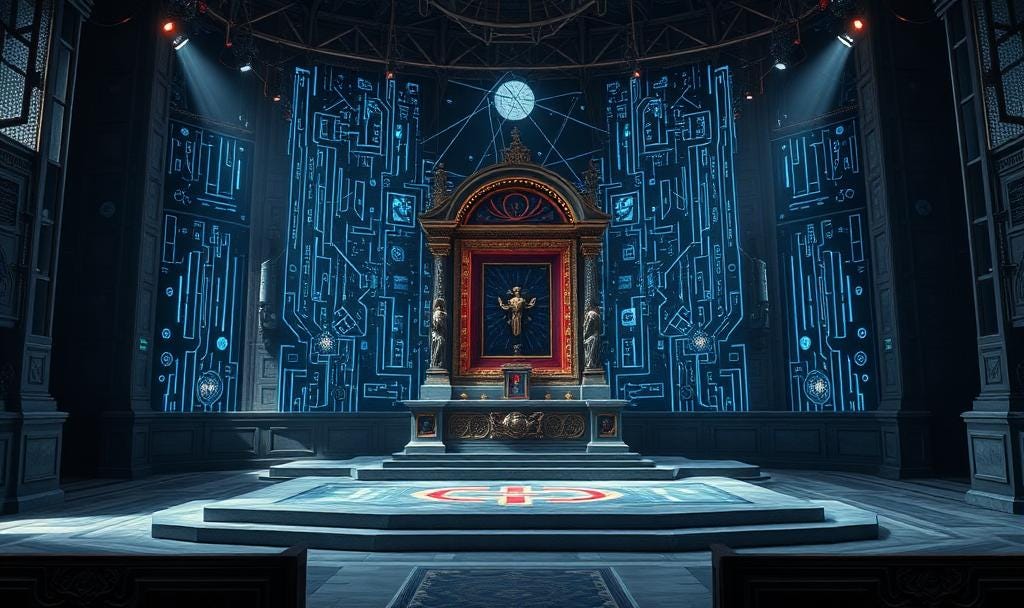
The Algorithm and the Altar
AI Platforms as the New Global Church By Henri Fouda, PhD, CEO of Amerafric Capital
Introduction: The Rise of a New Authority
AI platforms are no longer just tools. They are institutions—shaping what we know, how we behave, and who holds power.
In this essay, I explore an analogy that may sound provocative but reveals much about the current moment: Artificial intelligence platforms are becoming functional equivalents of the Catholic Church.
Both institutions:
• Transcend borders and claim universal reach
• Store and control knowledge
• Influence norms, behaviors, and politics
• Present themselves as necessary intermediaries between individuals and higher systems
What the Church once did with divine authority, AI now does with data.
From Rome to the Cloud
At its height, the Catholic Church unified the West under a shared worldview. It preserved sacred knowledge, interpreted morality, and negotiated with kings.
Today, global AI platforms—Google, Meta, OpenAI—play a similar role. They:
• Mediate the flow of knowledge
• Rank what’s relevant
• De-platform what’s heretical
• Train users to act according to invisible logics encoded in code
We trust their recommendations. We follow their rules. Most of us do not fully understand how they work.
Just as the Church once spoke in Latin, today’s digital institutions operate in inscrutable code.
The Politics of Platform Theology
The Church’s power came not just from doctrine, but from political alliances as well. Popes crowned emperors. Bishops shaped law.
Similarly, AI firms have aligned themselves with governments and militaries. They influence elections, moderate speech, and even shape wartime strategies. Their lobbying power in Washington, Brussels, New Delhi, Moscow, Abuja, Sao Paulo, Tokyo and Beijing rivals that of any religious institution of the past.
What we are witnessing is the birth of a new techno-political order, where algorithms shape trust and legitimacy is conferred by platforms.
Belief Without Religion
AI doesn’t offer salvation—but it does offer a simulacra of certainty. Predictive analytics, risk scores, and behavior optimization promise to reduce variance and ultimately uncertainty in a chaotic world.
The nascent belief system has already developed rituals—conferences, developer summits, evangelists. New sins are emerging —bias in training data. New prophets and doomsayers are emerging.
AI may not believe in anything, but it is already being believed in.
What Comes Next?
Let’s imagine the future in civilizational terms.
In 2500 AD, could OpenAI, Google, or a successor platform serve the role the Vatican once did—preserving memory, shaping ethics, maintaining global order?
Will AI produce schisms and reformations, heresies and councils? Will its engineers be seen as priests of a secular, computational faith?
These aren’t predictions. But they are serious possibilities.
What Should We Do With a Digital Church?
If AI platforms are the functional heirs to the Catholic Church, we face a difficult choice choice—both as citizens and investors.
Historically, societies have responded to religious institutions in two main ways:
1. Transform Them Into Public Utilities
The Church of England, for instance, was nationalized and repurposed as a state institution. Its powers were brought under public control—its wealth, its doctrine, even its leadership made answerable to the crown and eventually Parliament.
Could we do the same with technology platforms?
If platforms like Google or Meta mediate global knowledge, behavior, and even political legitimacy, perhaps they should be treated as digital public utilities—with oversight, public charters, and non-profit mandates governing key functions like search, communication, and knowledge storage.
2. Regulate Them Like the Church in America
The United States chose a different path: strict separation of church and state. Religious institutions were granted freedom—but also forbidden from exerting coercive influence over public law.
This might mean:
• No entanglement of AI platforms with law enforcement or military contracts
• No platform having the power to unilaterally silence speech
• Transparency requirements akin to financial disclosures or FOIA
• Strong limitations on algorithmic manipulation of democratic discourse
Either model is better than the status quo: opaque, unregulated, and dangerously powerful.
And From an Investment Perspective?
If these platforms truly are the Church of the Digital Age, then perhaps we are undervaluing them.
The Catholic Church, for all its crises, remains one of the longest-enduring power structures in human history—surviving schisms, empires, revolutions, and modernity itself.
So what does it mean that Google, Meta, Microsoft, and OpenAI now control the equivalent of global pulpits, libraries, and confessionals?
It means they are not just tech stocks.
They are global monopolies, norm-setting engines, and civilizational infrastructure.
And they may be cheap—not in price-to-earnings, but in price-to-power.
Conclusion: Not Religion, but Replacement
AI platforms are not the new religion. They don’t promise transcendence or eternal life.
They may, however, become the new Church: institutions that mediate truth, enforce norms, and operate globally beyond the reach of any one state.
If we do not recognize their role, we risk misunderstanding both their power—and our place in the systems we are building.
Further Reading
• Foucault, Discipline and Punish
• Zuboff, The Age of Surveillance Capitalism
• Bostrom, Superintelligence
• Harari, Homo Deus
• O’Neil, Weapons of Math Destruction